Why Does My 9 Month Old Baby Drool So Much
Our three-year-onetime was recently diagnosed with autism. He has made progress and is at present talking, requesting and labeling. Just he drools all the fourth dimension, and we have to wipe his confront constantly. How can nosotros help him not drool?

Today'south "Got Questions?" answer is past behavior analyst Kara Reagon, Autism Speaks associate manager for dissemination science.
Editor'south annotation: The following data is not meant to diagnose or treat and should not take the place of personal consultation, equally appropriate, with a qualified healthcare professional.

Everybody drools – at least to start. Typically developing infants start to gain command of their swallowing and rima oris muscles betwixt eighteen and 24 months of age. But it's mutual for children with developmental disorders to drool excessively and for longer than is typical with other children. This includes children with autism, many of whom have delays and difficulties with muscle control and sensitivity.
What causes excessive drooling?
Typically, drooling involves depression muscle tone, a lack of sensitivity around the lips and face, difficulty swallowing and/or excessive production of saliva. A variety of neurological and attention deficits tin contribute to these issues – as is often the case among children – and sometimes adults – who have autism.
You are correct to be concerned. Drooling becomes socially stigmatizing when it continues beyond infancy. Information technology'southward also unhygienic – an important consequence as your son enters group settings such every bit preschool.
That said, drooling in some situations – for case, while sleeping – is mostly harmless unless it'southward and then excessive that your child is inhaling saliva.
So permit's focus on your son's tendency to drool during the solar day.
Evaluation and treatment options
First, it's important to discuss your son's drooling with his pediatrician or a pediatric ear-nose-pharynx specialist to accost or rule out serious underlying medical conditions. This will likely involve an test of his tonsils, sinuses, and salivary glands. Also, certain medications tin worsen drooling – another issue to hash out with your son'south doctor. In addition, the doctor should evaluate whether your son'south drooling is resulting in his inhaling saliva into his lungs – putting him at gamble for pneumonia.
Treatment options should be tailored to your son'south needs and may crave further evaluation – for instance by a speech-language pathologist or occupational therapist experienced in oral-sensitivity and muscle tone issues.
Oral communication and occupational therapists can help your son improve his oral musculus tone, lip closure and swallowing. In some cases, the therapist may suggest a dental appliance or chin cup to assist in lip closure, tongue positioning and swallowing.
It may likewise help to reduce the amount of acidic foods your son is eating – equally they tin can trigger the product of excessive saliva. Just information technology's important to piece of work with a dietician before introducing whatsoever meaning change to your son's diet – particularly if he'due south already a picky eater.
The goals of therapy
Generally drooling can be addressed through occupational and/or spoken language therapy that focuses on the following:
1. Develop practiced posture and positioning
Sometimes, poor muscle command of the trunk, neck and head results in the head tilting downward. In this position, saliva tends to pool at the front end of the mouth and spill from parted lips. The therapist can assist you position your child in ways that encourage proper torso control and caput support.
2. Build oral muscle strength and control.
Therapists use a variety of playful oral-motor exercises to assistance children build muscle tone effectually the mouth. For instance, the therapist may have your son practice closing his lips around a straw, spoon or a piece of nutrient and/or practice pronouncing closed-lip oral communication sounds such as "p," "b" and "thou." The therapist will show you lot how to go along these exercises at home, with lots of encouragement in the form of praise and/or pocket-sized rewards.
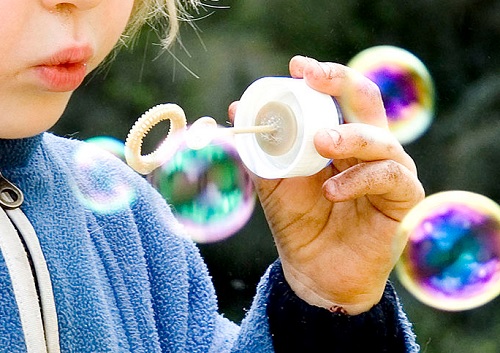
3. Increase oral sensitivity. Similarly, therapists take a diversity of tactile exercises that tin assist your child develop sensitivity in the lips, natural language, oral fissure and chin. This includes building awareness of dryness versus wetness – and so your kid becomes aware when he's drooling. Playful oral-sensitivity exercises can include blowing bubbles, making exaggerated sounds involving the lips such as "oooo," "eeee" and "puh-puh-puh." Again the therapist will give y'all guidance on how to practice these exercises at habitation.
4. Practice proper chewing and swallowing. Does your kid drool excessively while eating? If so, you and the therapist can piece of work with your child to chief the steps of proper chewing and swallowing. It's helpful to practice these exercises when your child is hungry enough to enjoy a snack but not ravenous. In general, the therapist will show you how to model, or exaggerate, advisable chewing motions (closing the teeth and and then the lips, etc.) and encourage your kid to do the aforementioned. It can help to give your son a hand-held mirror so he can lookout himself perform these steps. As always, remember to encourage and praise, as in:
"That'south cracking. You're chewing your cracker. Awesome, you swallowed the cracker! Good eating."
5. Practice wiping with a napkin or handkerchief. While your kid is learning to go aware of wetness on his face, it's important to encourage the socially advisable practice of wiping with a napkin or handkerchief. For mealtimes, I suggest education him the habit of "wipe, wipe, swallow" – wiping one side of the mouth and then the other before swallowing. Consider attaching the napkin to a wristband during meals to encourage this habit.
You mention that your son drools continuously. Then you'll also want to teach him the habit of wiping with a handkerchief when not at the dinner table. This includes helping him learn to keep a clean handkerchief handy in a pocket. Another option is have your son habiliment wrist sweatbands and encourage him to use them to wipe each side of his confront regularly.
Both at the dinner table and away, you lot'll want to cue your child – mayhap by properly wiping your own mouth – when you see him drooling.
6. Put information technology all together with rewards.
Exist sure to create a reward system to reinforce each step your child takes with chewing, swallowing, wiping and almost chiefly keeping a clean, dry out face up. At age iii, you may want to proceed this elementary – with lots of praise and small rewards. But your son may be onetime enough to relish a token system that involves earning larger rewards such as a favorite action with you lot.

Got more questions for our behavioral and medical experts? Transport them to GotQuestions@AutismSpeaks.org .
Source: https://www.autismspeaks.org/expert-opinion/autism-and-drooling-why-so-common-what-helps
0 Response to "Why Does My 9 Month Old Baby Drool So Much"
Post a Comment